Websites · Search & AI discoverability
Polynovea & Infrakinetic Websites
Three production websites (company, product and careers), plus the SEO and AI-search engine behind them, designed and shipped end to end.
Overview
I designed Polynovea’s public web presence and shipped it with Claude writing the code: three sites with three different jobs.
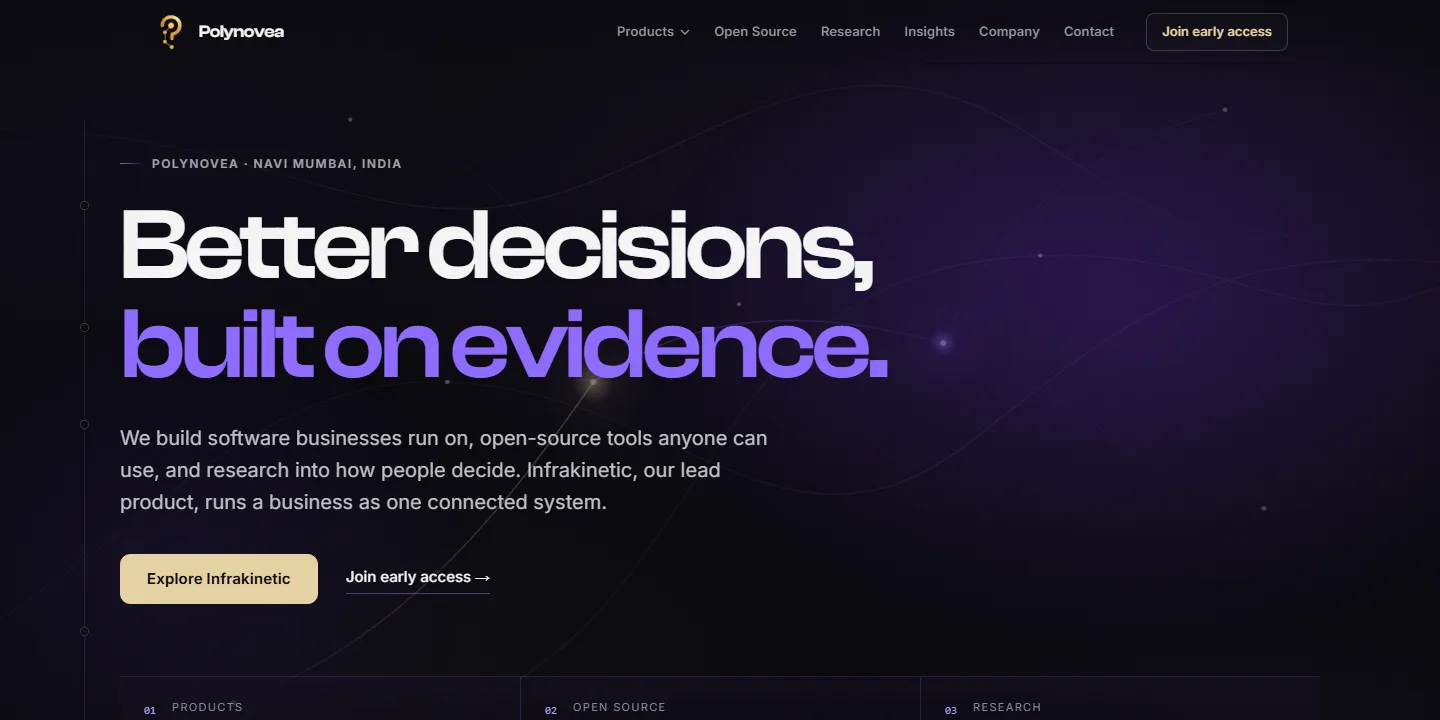
- polynovea.in explains the company: its products, open-source work, architecture and research.
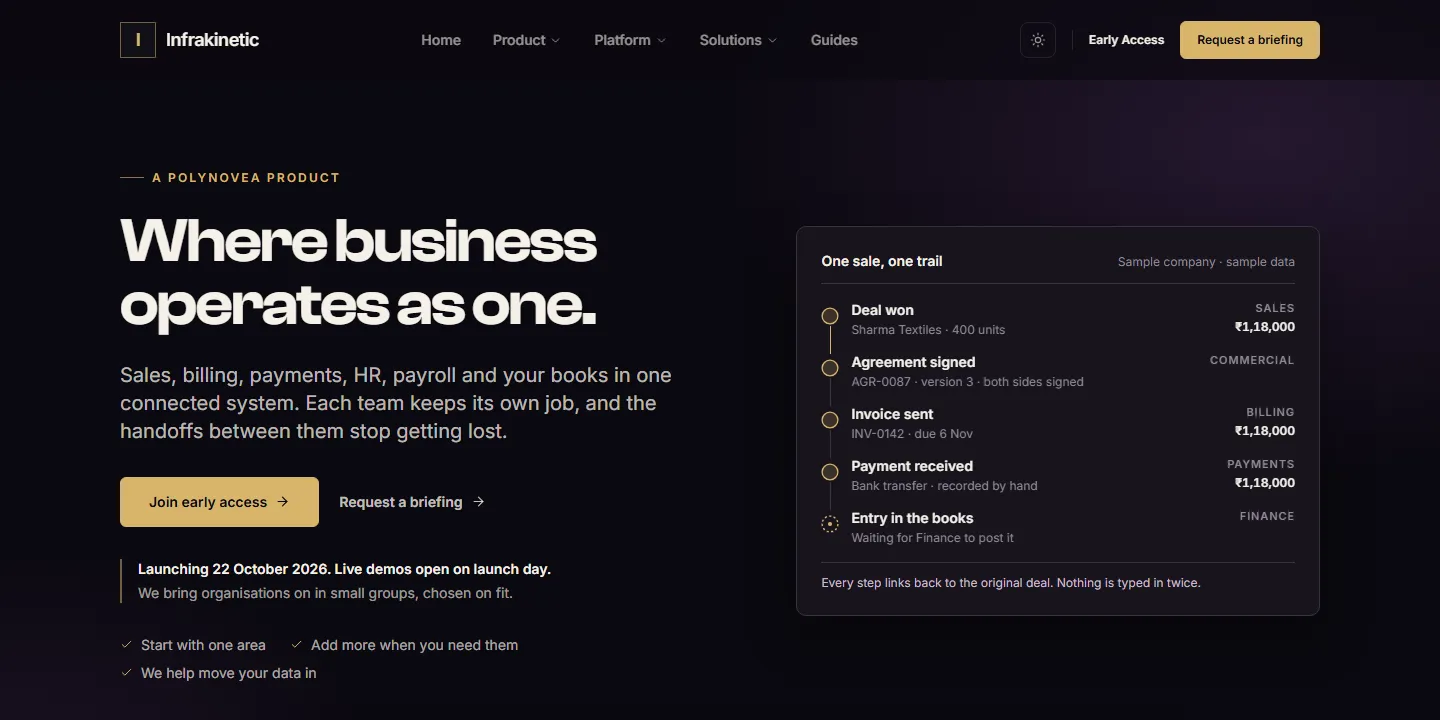
- infrakinetic.in sells the product. It runs early-access sign-up ahead of launch and carries a library of practical guides written for real search demand.
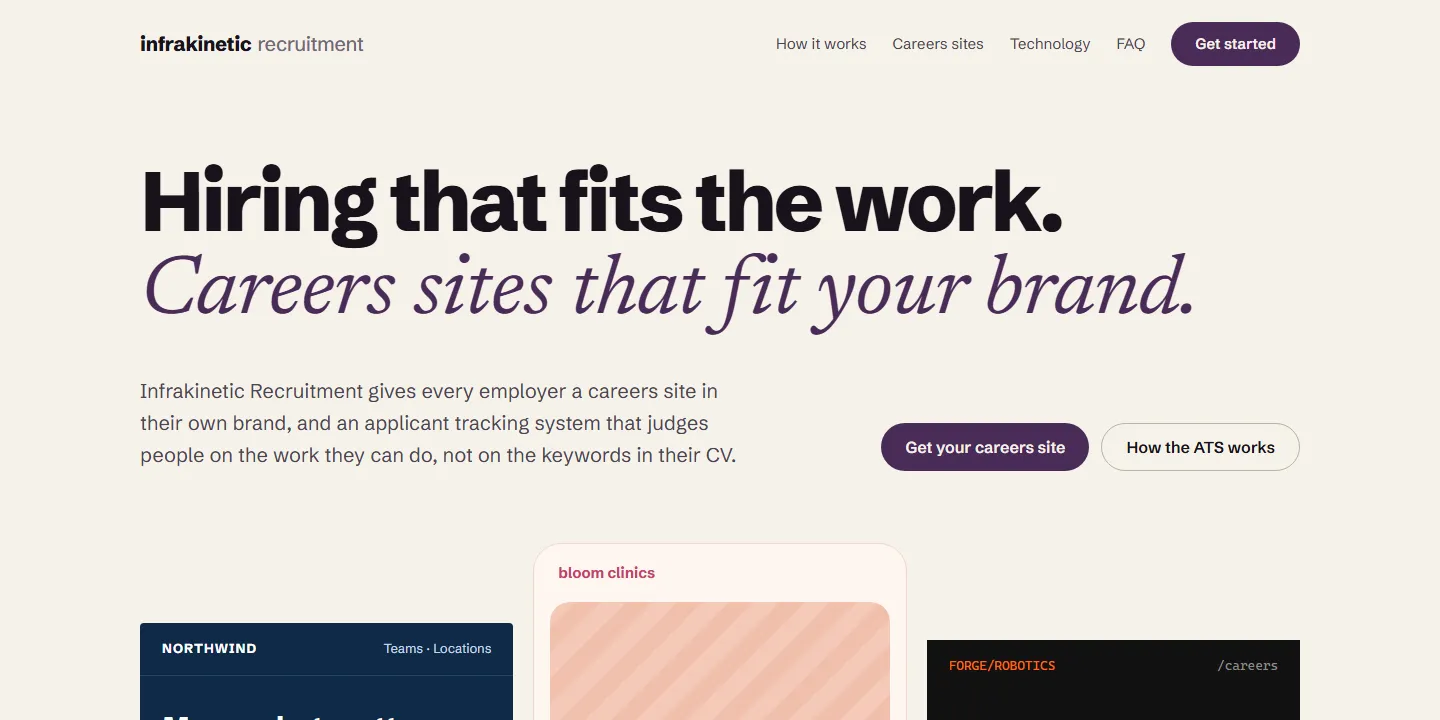
- careers.infrakinetic.in is the public face of Infrakinetic Recruitment: the product’s own pages, plus careers sites that each employer gets in their own brand.
Behind all three sits a small SEO and AI-search engine I built to plan, audit and write for search.
The problem
A company with an enterprise platform, an open-source project and a research programme is hard to explain on one page. Each audience (a finance lead evaluating software, a developer looking at the open-source code, a candidate applying for a job) needs a different entry point, and all of them increasingly arrive through AI assistants as well as search engines.
Constraints
- Several audiences, one brand. Company, product and careers each need their own voice without becoming three unrelated brands.
- Found by search and by AI. Pages need to rank, and to be quoted correctly by answer engines.
- Owned and operated by one person. Low maintenance, cheap to run, and safe to change.
- Security by default. Public sites shouldn’t be the weak point of a company that sells governance.
My role
The information architecture, design systems, copy direction, and search and AI-discoverability strategy are mine, along with deployment. The code is written with Claude.
Reasoning and architecture
- polynovea.inCompany, products, open source, architecture, research. Next.js on Vercel.
- infrakinetic.inProduct pages per category, platform and migration pages, early access, and a guide library. Next.js on Vercel.
- careers.infrakinetic.inRecruitment product pages and employer-branded careers sites, served from the Infrakinetic platform on Cloudflare Pages.
- Search and AI layerSitemaps, schema.org structured data, llms.txt, explicit crawler policy.
Search-led product site. Infrakinetic’s site is organised the way buyers search: one page per category (CRM, ERP, HR, payroll, billing, finance, document management, workflow automation, data migration), with a library of 39 guides underneath on problems buyers actually type into a search box, such as CRM migration checklists, payroll reconciliation and why CRM and accounting sync breaks. Each guide answers one question and links back to the product page it supports.
Written for AI answers as well as rankings. All three sites publish structured data and an llms.txt index. The careers site states its policy for search engines and AI assistants explicitly in robots.txt, including content signals.
Careers as part of the product. The careers site isn’t a separate marketing build. It’s served by Infrakinetic’s recruitment engine, so every employer’s job pages come from the same system that runs their hiring workflow.
Implementation
- polynovea.in: Next.js 16, React 19, Tailwind CSS 4 and TypeScript, with Supabase-backed forms validated by Zod, on Vercel.
- infrakinetic.in: Next.js on Vercel, with strict security headers (HSTS, content-type, referrer and permissions policies) and a content security policy.
- careers.infrakinetic.in: Cloudflare Pages with a locked-down content security policy (
default-src 'none'), schema.orgSoftwareApplicationmarkup and per-employer branding.
The SEO and AI-search engine
The search strategy runs on a command-line engine I built for it, with five modes over one core:
- ExploreFinds what people really search for instead of an internal buzzword.
- ResearchTopic → autocomplete keyword pool → ranked brief.
- AuditCrawls a live site, scores each page, and produces fix suggestions.
- ContentOne keyword → a standalone page built for search and AI answers.
- Pre-buildBusiness profile → pillar-and-cluster keyword strategy → a multi-page site plan.
Keywords come from real Google Autocomplete data, not a model’s guesses. Prompts encode current SEO and generative-engine-optimisation practice from four research reports: one primary keyword per page, pillar-and-cluster linking, intent classification, question-shaped headings that AI systems can lift as answers, and schema types per page. Each step is routed to the cheapest model that does it well. Audits rotate across free tiers, and the strongest model is kept for page generation, which keeps the whole pipeline close to free.
Evidence and outcomes
All three sites are live; the links are in the panel. infrakinetic.in publishes 59 indexed URLs and polynovea.in 16, each with sitemaps, structured data and an llms.txt index.
Verdict
- Keep: product sites organised around what buyers search for, with one guide per real question, each feeding a product page. That ranks, and it’s what AI answers quote.
- Keep: careers as part of the product, not a separate marketing build, so job pages and hiring workflow share one system.
- Keep: route each step to the cheapest model that does it well, and spend on the strong model only where a reader sees the output.
- Change: SEO fixes should be drafts with their source facts attached and a human approval, not copy-paste patches. That’s how the pattern was rebuilt inside Infrakinetic’s marketing engine.